
 English
  русский
  عربى
عربى 
How to Descale Steel Wire: Mechanical vs Chemical Methods for Clean Drawing
Author: Admin
Date: Aug 20,2026
A coil of hot-rolled steel wire rod carries up to 20 kilograms of mill scale per tonne. Feed that scale into a drawing die and it behaves like loose grit: die wear accelerates, the wire surface scratches, and rejection rates climb in downstream cold heading, galvanizing, or plating operations. How to descale steel wire is therefore a production-planning decision, not a maintenance detail.
Mill scale forms when wire is hot rolled at 900-1200°C and cools in air. The brittle oxide layer is harder than the base metal and contains three compounds: wustite (FeO) closest to the steel, magnetite (Fe3O4) in the middle, and hematite (Fe2O3) on the outside. A plant taking delivery of 50,000 tonnes of rod per year handles 500 to 1,000 tonnes of this abrasive oxide, and every gram left on the surface shortens tool life and degrades product quality.
Content
- 1 Why You Must Descale Steel Wire Before Drawing
- 2 How to Descale Steel Wire Mechanically: Bending, Brushing, and Air Blasting
- 3 Chemical Descaling: When Acid Pickling Still Makes Sense
- 4 Choosing the Right Way to Descale Steel Wire: A Method Comparison
- 5 In-Line Descaling: Process Integration Without Extra Handling
- 6 Frequently Asked Questions About Wire Descaling
Why You Must Descale Steel Wire Before Drawing
Steel wire cannot be drawn economically with mill scale on the surface. The oxide layer measures 400 to 600 HV, roughly double the hardness of annealed or low-carbon wire, and it fractures into sharp particles inside the die contact zone.
Those particles cause three measurable problems. Die wear increases by 40 to 60 percent in plants that run un-descaled rod, because scale acts as abrasive between the wire and the carbide or diamond die. Surface quality drops as fractured particles are pressed into the wire, creating longitudinal scratches that cause rejects in fastener, spring, or tire-cord lines. Coating adhesion fails when scale residues block zinc phosphate or lime coatings, leaving an uneven lubricant carrier and higher drawing forces.
- Wustite (FeO): thickest layer, softest of the three, dissolves most readily in mild acid.
- Magnetite (Fe3O4): dense and tightly bonded; the layer that resists mechanical bending.
- Hematite (Fe2O3): thin outer layer, hard and brittle; fractures first during bending.
How to Descale Steel Wire Mechanically: Bending, Brushing, and Air Blasting
Mechanical descaling removes 85 to 95 percent of the oxide layer by bending the wire repeatedly over pulleys and stripping the loosened scale with brushes or air jets. It is the default choice for in-line drawing because it produces no acid, no rinse water, and no liquid waste, and it runs at the same speed as the drawing line.
Wire passes over several pulleys in alternating directions, and each bend stretches the surface layer. The brittle scale cracks and detaches in flakes; rotating steel brushes and compressed air then clear the particles before the wire enters the die box. A typical unit uses four to six bend cycles, with pulley diameters matched to the wire size, plus dust extraction to keep the work area clean.
Mechanical descaling is a surface-preparation process that fractures brittle mill scale through reverse bending of the wire and removes the loosened oxide with brushes, air jets, or both, so the wire enters the drawing die with a clean, uniform surface.
Mechanical descaling works best on freshly rolled rod with intact, crack-free scale. Heavily rusted or stored rod scales unevenly, and the residual 5 to 15 percent of oxide left after bending is still too much for plating-grade or cold-heading wire, which demands a clean substrate before coating or forming.
Chemical Descaling: When Acid Pickling Still Makes Sense
Acid pickling dissolves mill scale chemically and reaches 98 to 100 percent removal, which is why it remains the standard when the downstream process demands a fully oxide-free surface. It is not a cheap alternative to mechanical descaling; it is a precision step with its own chemistry, heating, and waste-handling requirements.
Two acids dominate wire pickling: hydrochloric acid (HCl) and sulfuric acid (H2SO4). HCl works at 20-40°C with faster dissolution and less base-metal attack, but it costs more and needs fume control. H2SO4 is cheaper per tonne but requires 60-80°C, creates more acid carry-over into rinse tanks, and leaves a smut residue on higher-alloy wires.
| Parameter | Hydrochloric acid (HCl) | Sulfuric acid (H2SO4) |
| Working temperature | 20-40°C | 60-80°C |
| Typical concentration | 10-20% | 10-25% |
| Removal speed | Fast, short immersion times | Slower, longer immersion times |
| Base-metal loss | Low when inhibited | Higher; needs inhibitor control |
| Primary drawback | Higher acid cost and fume extraction | Higher energy cost and acid carry-over |
Pickling is never a standalone step. After the acid bath, wire is rinsed and coated with lime, borax, or phosphate to carry lubricant into the die and prevent re-rusting. Waste acid, rinse water, and fume need treatment or regeneration, which is why total chemical descaling cost usually runs 2 to 3 times the direct acid cost per tonne.
For plating-quality wire, spring wire, or bearing wire, pickling's near-total scale removal justifies its cost. For standard drawing of clean rod, the same result can be achieved more cheaply with mechanical descaling, which is why most modern high-speed lines start with bending and brushing and add pickling only for critical grades.
Choosing the Right Way to Descale Steel Wire: A Method Comparison
Choose mechanical descaling for high-speed drawing of clean, freshly rolled rod; choose chemical pickling when the rod is heavily rusted, the finish requires a fully scale-free surface, or the process already includes coating baths. The decision rests on four factors: incoming rod condition, line speed, surface requirements, and environmental limits.
Mechanical descaling
- 85-95% scale removal, dry process
- Runs in-line at full drawing speed
- No acid, no waste water, dry dust only
- Lowest cost per tonne on clean rod
- Leaves a thin residual oxide layer
Chemical pickling
- 98-100% scale removal, oxide-free surface
- Batch or in-line, with heating and ventilation
- Acid, rinse water, and fume treatment required
- Higher cost per tonne, plus a coating step
- Essential for plating, cold heading, tire cord
85-95%Removal by bending and brushing
98-100%Removal by HCl pickling
40-60%Die-life loss without descaling
0 LLiquid acid waste, mechanical line
Scale removal efficiency by descaling method
Selection rule: run mechanical descaling when rod is clean and the drawing schedule is standard; add acid pickling when the rod shows visible rust or the product requires plating, cold heading, or tire-cord finish.
In-Line Descaling: Process Integration Without Extra Handling
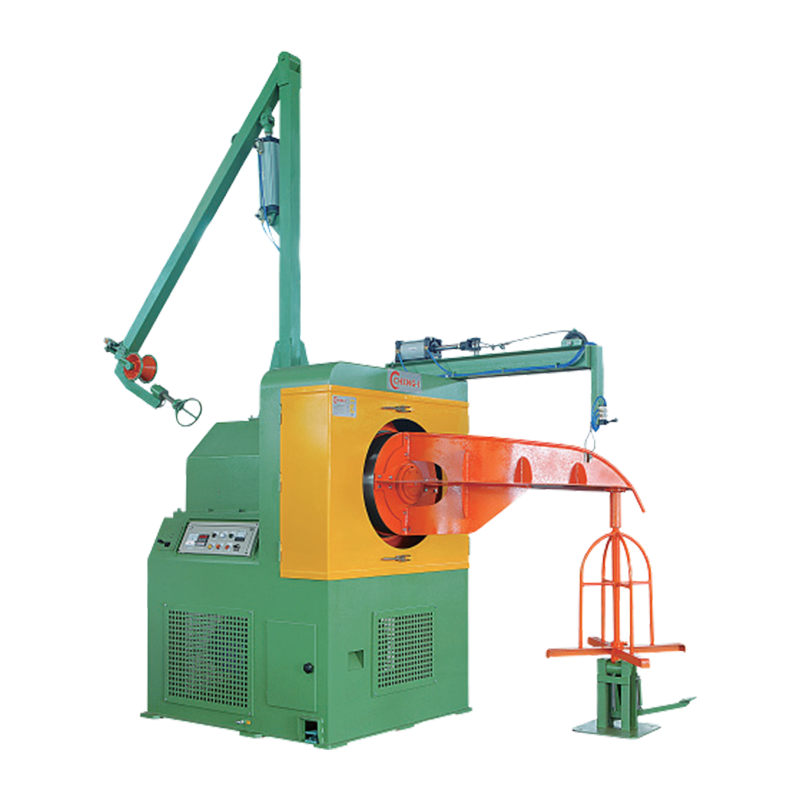
A modern wire drawing line integrates descaling directly between the pay-off and the first die, so descaling adds no extra handling step and runs at line speed. This is the configuration that CHENG-I PREMIUM WIRE EQUIPMENT (CHENG-I) builds into its pay-off, descaling, drawing, and take-up packages.
An in-line mechanical descaling station follows this sequence:
- Pay-off with tension control feeds the coil at a constant speed and keeps the wire from twisting between the coil and the first pulley.
- Reverse bending unit flexes the wire over four to six pulleys; the alternating bends crack the brittle oxide layer while the wire stays below its yield limit.
- Brush and air-blow station strips the fractured scale from the surface; brush material, pressure, and air volume are matched to wire diameter and line speed.
- Dust collection captures the dry oxide particles before they can settle on the die box, the lubricant, or the finished coil.
- Die box entry receives wire with 85-95% of the scale removed and a uniform surface that picks up drawing lubricant evenly.
Equipment selection depends on wire range and speed. A descaling machine for 5.5-13 mm rod in a dry drawing line typically runs at 2-5 m/s, while heavier rod needs larger pulley diameters and higher brush power. CHENG-I, founded in 1970 with manufacturing in Tainan, Taiwan and Guangde, Anhui, China, supplies CE-certified descaling machines and complete wire processing lines to fastener, tire-cord, spring-wire, and bearing-wire producers in the United States, Europe, Southeast Asia, India, and Japan.
The most cost-effective descaling decision is made at the plant-planning stage: choosing mechanical, chemical, or combined descaling equipment before the line is built, rather than retrofitting it after die costs and reject rates have already exposed the problem.
Frequently Asked Questions About Wire Descaling
Can mechanical descaling remove all mill scale from steel wire?
No. Mechanical descaling removes 85 to 95 percent of the oxide layer. It fractures and brushes off the bulk of the scale but leaves a thin, tightly bonded residue in surface valleys. For plating, cold heading, or tire-cord wire, that residual layer must be removed with a light acid pickle.
What is the difference between descaling and pickling?
Descaling is the general process of removing oxide scale from steel wire, while pickling is a specific chemical method that uses acid to dissolve the oxide. Mechanical descaling removes scale by bending and brushing; pickling relies on chemical dissolution and leaves a fully oxide-free surface.
What wire diameters can an in-line mechanical descaling machine handle?
Most reverse-bending descaling machines are built for wire rod from 5.5 mm up to 25 mm in diameter. Below 5.5 mm, bending forces become difficult to control and chemical pickling is more common, because thin wire does not generate enough surface strain to crack the scale reliably.
Does descaling slow down the drawing process?
In-line mechanical descaling does not reduce drawing speed when the machine is correctly sized, because the descaling station runs synchronously with the drawbench. Acid pickling, by contrast, is often a batch step that adds handling time; when pickling is installed in-line, line speed is limited by immersion time and the rinse and coating sections.
Contact Us Now
Related products
Related News
 For precision wire machinery or
integrated plant solutions, please
contact the
CHENG I Sales & Engineering Team.
For precision wire machinery or
integrated plant solutions, please
contact the
CHENG I Sales & Engineering Team.


Product Category
Wire Descaling Machine WIRE DRAWING MACHINE Take-Up Coiler Cutting Machine Pay-Off Machine Other Equipment/AccessoriesContact Us

+86-563-6616199 (Ext: 105, 103, 111)

+86-15167365999

John Wang & Elaine Zhao

sales@chengiwire.com

No. 8 Keji Road, North District, Guangde Economic Development Zone, Xuancheng City, Anhui Province, China
Copyright © CHENG I Wire Machinery Co. Ltd. All
Rights
Reserved
Wire Machinery Manufacturer | CHINA
